

Why Oil & Gas Companies Fail at AI (And How to Fix It)
A midstream operator I worked with last year invested hundred of thousands on AI tools.
Eighteen months later, their ROI was exactly zero.
The predictive maintenance platform they’d purchased was still in “pilot mode.” The document intelligence system had been used twice. The vendor relationship had soured. And the executive team had quietly written off AI as “not ready for our industry.”
Here’s the thing: the technology wasn’t the problem. Every tool they’d purchased was capable of delivering value. The failure happened before a single line of code was deployed.
Most oil & gas companies aren’t losing the AI race because of bad technology. They’re losing it because of bad strategy.
After working with operators across upstream, midstream, and downstream environments, I’ve identified the patterns that separate companies capturing real ROI from those burning budget on tools that never deliver. The difference isn’t technical sophistication. It’s strategic discipline.
Here’s what’s actually going wrong — and how to fix it.
The AI Hesitation Trap in Oil & Gas
Oil & Gas operates in an environment where caution makes sense. Regulatory complexity is real. Data sensitivity is real. The operational disruption risk from a botched implementation is real. Why oil and gas is slow to adopt AI?
But somewhere along the way, legitimate caution turned into paralysis.
I talk to operations leaders every week. The conversations follow a familiar script:
“We know we need to do something with AI, but we’re not sure where to start.”
“We tried a pilot a year ago. It didn’t go anywhere.”
“Our data is too sensitive. We can’t risk putting it in the cloud.”
“We’re waiting to see how the industry moves first.”
Meanwhile, their competitors aren’t waiting. According to a 2025 Deloitte analysis, oil & gas companies with mature AI implementations report 20–30% reductions in unplanned downtime and 15–25% improvements in operational efficiency. The gap between AI leaders and laggards is widening — and it compounds quarterly.
The hesitation trap isn’t about being careful. It’s about confusing caution with inaction.
Inaction has a cost. Most companies just never calculate it.
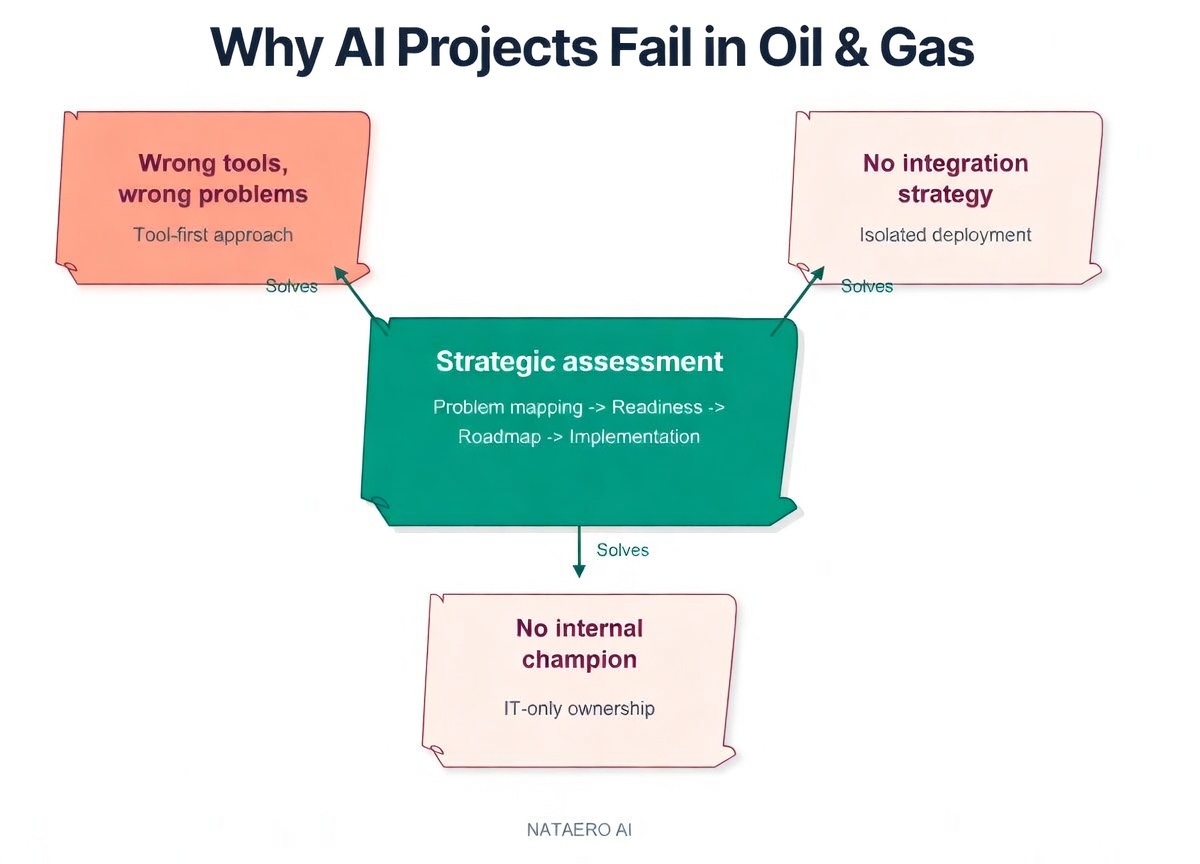
The 3 Failure Patterns Killing AI Initiatives
After analyzing dozens of failed AI projects in energy, I’ve identified three failure modes that show up consistently. If you’re planning an AI investment — or trying to diagnose why a past one didn’t work — start here. Not addressing these issues is a critical reason why oil and gas companies fail at AI.
Failure Pattern 1: Wrong Tools, Wrong Problems
This is the most common failure mode, and it almost always starts the same way.
A company attends an industry conference. They see impressive demos. They get pitched on AI platforms that promise to “transform operations.” They buy the software. They deploy it.
Then they discover the tool doesn’t solve their most pressing operational problems. Or it solves a problem they don’t actually have. Or it requires data infrastructure they haven’t built yet.
The result: expensive software collecting dust while real inefficiencies persist.
How to avoid it: Identify your highest-impact problems before you evaluate any tools.
What’s actually costing you money right now? Where are your engineers losing hours to manual processes? What equipment failures keep recurring despite your current maintenance approach?
Start with problems, not products. This single shift prevents more AI failures than any other intervention I’ve seen.
Failure Pattern 2: No Integration Strategy
AI deployed in isolation is AI that fails.
I’ve seen companies implement sophisticated predictive maintenance models that generate accurate failure alerts — alerts that nobody ever sees because the system isn’t connected to the platforms where maintenance teams actually work.
I’ve seen document intelligence tools that can search thousands of files in seconds — but only for the 20% of documents that happen to live in the one system the AI can access. The other 80%? Still buried in disconnected repositories.
The result: another data silo. Engineers still searching manually. Maintenance teams still reacting instead of predicting. Nothing changes.
How to avoid it: Build integration into the plan from day one.
Before you select any AI solution, map exactly how it will connect to your existing systems — SCADA, CMMS, DMS, ERP, whatever you’re running. If the integration path isn’t clear, the deployment will fail. This isn’t a technical detail to figure out later. It’s a strategic requirement that shapes which solutions are even viable.
Failure Pattern 3: No Internal Champion
AI projects without operational ownership don’t scale. I’ve never seen an exception.
Here’s the pattern: Leadership decides the company needs AI. They assign the project to IT because “it’s a technology initiative.” IT evaluates vendors, runs a pilot, generates a report. The pilot shows promise but never gets adopted. Operations never bought in. The project dies quietly.
Or worse: the project technically “succeeds” but stays a pilot forever. No one has the authority or incentive to push it into production workflows. No one is accountable for ROI. The vendor keeps getting paid. Nothing changes operationally.
How to avoid it: Secure a cross-functional champion before you start.
This isn’t about assigning a project manager. It’s about identifying someone in operations — with real authority — whose performance is tied to the AI initiative’s success. When someone’s bonus depends on the project delivering results, the project delivers results.
The Strategic Assessment Approach
So what does it look like when companies get it right?
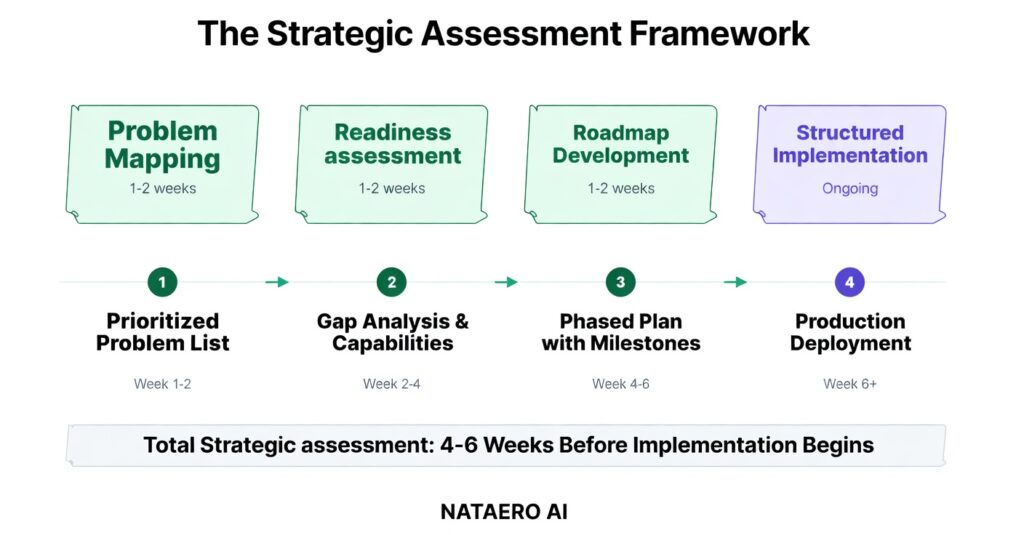
The operators I’ve seen capture real ROI from AI follow a structured approach that addresses all three failure modes before they spend a dollar on tools. Learn why oil and gas companies fail at AI.
Phase 1: Problem Mapping
Before evaluating any AI solution, they conduct a systematic assessment of operational pain points. Not a vague discussion about “digital transformation” — a specific inventory of where time, money, and resources are being lost.
The questions that matter:
· Where are engineers spending hours on tasks that could be automated?
· What failures keep recurring despite current maintenance programs?
· Where are decisions being made on incomplete or delayed information?
· What compliance or reporting processes consume disproportionate resources?
The output is a prioritized list of problems ranked by operational impact and AI solvability.
Phase 2: Readiness Assessment
Once you know what problems you want to solve, you assess whether you’re ready to solve them. This means evaluating four dimensions: data quality, infrastructure, talent, and governance.
For example: if predictive maintenance is your target, do you have sufficient sensor coverage on critical equipment? Is your historical maintenance data clean and accessible? Do you have internal expertise to interpret model outputs, or will you need to build that capability?
Readiness gaps aren’t deal-breakers. They’re inputs to the roadmap. But identifying them upfront prevents expensive mid-implementation surprises.
Phase 3: Roadmap Development
With problems prioritized and readiness assessed, you build a phased implementation roadmap that sequences initiatives based on impact, feasibility, and dependencies.
The best roadmaps start with quick wins — high-impact, low-complexity use cases that deliver measurable results in 60–90 days. These early wins build credibility, generate momentum, and create internal advocates for larger initiatives.
Phase 4: Structured Implementation
Finally, implementation with clear governance: defined success metrics, regular checkpoints, and explicit ownership at every stage. Integration planned from the start. Operational champions secured. Feedback loops built in so you can adjust as you learn.
Ready To Start Your AI Strategy for Oil and Gas?
Request a Free Consultation
Data sensitivity is a legitimate concern — and a solvable one. The question isn’t whether to use AI; it’s how to deploy it securely. Modern deployment architectures allow AI to run entirely within your environment, with data never leaving your servers or crossing network boundaries. The key is selecting partners who understand industrial security requirements and can demonstrate compliant, on-premise or air-gapped deployment options.
A comprehensive strategic assessment typically takes 4–6 weeks, depending on organizational complexity. This includes problem mapping, readiness assessment, and roadmap development. The time investment is minimal compared to the cost of a failed implementation — and it dramatically increases the likelihood of success.
Almost never. The most effective AI implementations integrate with your existing infrastructure rather than replacing it. Your SCADA, CMMS, DMS, and ERP systems contain the operational data AI needs to deliver value. The goal is to make those systems smarter and more connected — not to throw them away and start over.
Start at the intersection of high impact and low risk. For most oil & gas operators, that means one of three entry points: document intelligence (searching and retrieving critical documents across disconnected systems), predictive maintenance (identifying equipment
anomalies before failure occurs), or automated compliance reporting (reducing the manual burden of HSE and regulatory documentation). These use cases deliver measurable ROI within 90 days and build organizational confidence for larger initiatives.
With a strategic approach, most companies see measurable results from their first AI use case within 60–90 days of deployment. Full ROI realization — including productivity gains, cost avoidance, and efficiency improvements — typically occurs within 6–12 months. The key variable is starting with a well-scoped use case rather than attempting a broad transformation all at once.
Strategic consulting typically represents 10–15% of a full AI implementation budget — but it routinely prevents 50–100% budget waste on failed initiatives. The companies that skip strategic assessment don’t save money; they spend the same money twice (or three times) before getting it right.
Your Next Step
If you’re planning an AI investment — or trying to understand why a past one didn’t deliver — the framework above is your starting point.
Map your problems before you evaluate tools. Assess your readiness honestly. Build integration into the plan from day one. Secure operational champions who own the outcome.
Skip any of these steps, and you’re likely to join the long list of oil & gas companies whose AI investments delivered nothing.
Get them right, and you’ll be capturing efficiency gains while your competitors are still debating whether AI is “ready for the industry.”
It is. The question is whether your strategy is ready for AI.