

The $500K AI ROI Opportunity in Oil & Gas Most Energy Companies Are Ignoring
The most expensive decision most oil & gas operators make isn’t a bad technology investment. It’s the decision to keep waiting.
Every month without AI-assisted maintenance scheduling, document retrieval, or anomaly detection is a month your operations absorb unnecessary costs — and a month your more aggressive competitors pull further ahead in the energy sector.
This post isn’t about AI hype. It’s about AI opportunity cost in energy — the kind that compounds on your P&L whether or not you ever deploy a single AI tool. Here’s exactly where that cost is hiding and how to quantify your AI ROI in oil and gas before you spend a dollar.
Where Oil & Gas Operations Leak Time and Money
Most energy executives know their operations aren’t perfectly efficient. What they often miss is how predictable that inefficiency is — and how directly it maps to AI capabilities that are production-ready today.
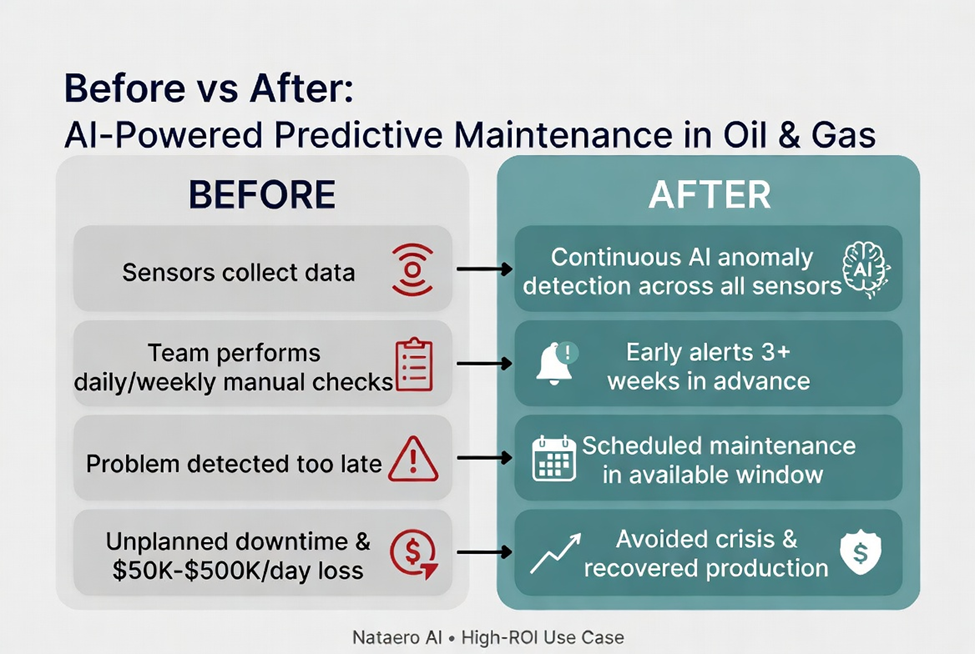
- Unplanned Maintenance and Equipment Failure Unplanned downtime in upstream and midstream oil & gas can cost $50,000 to $500,000 per day depending on asset class, production volume, and location. Beyond direct production loss, there’s emergency labor, expedited parts, HSE incident risk, and regulatory burden.
AI predictive maintenance oil and gas doesn’t eliminate failure — it shifts when you find out about it. You discover problems weeks earlier, during a scheduled window. The failure doesn’t disappear; the crisis does.
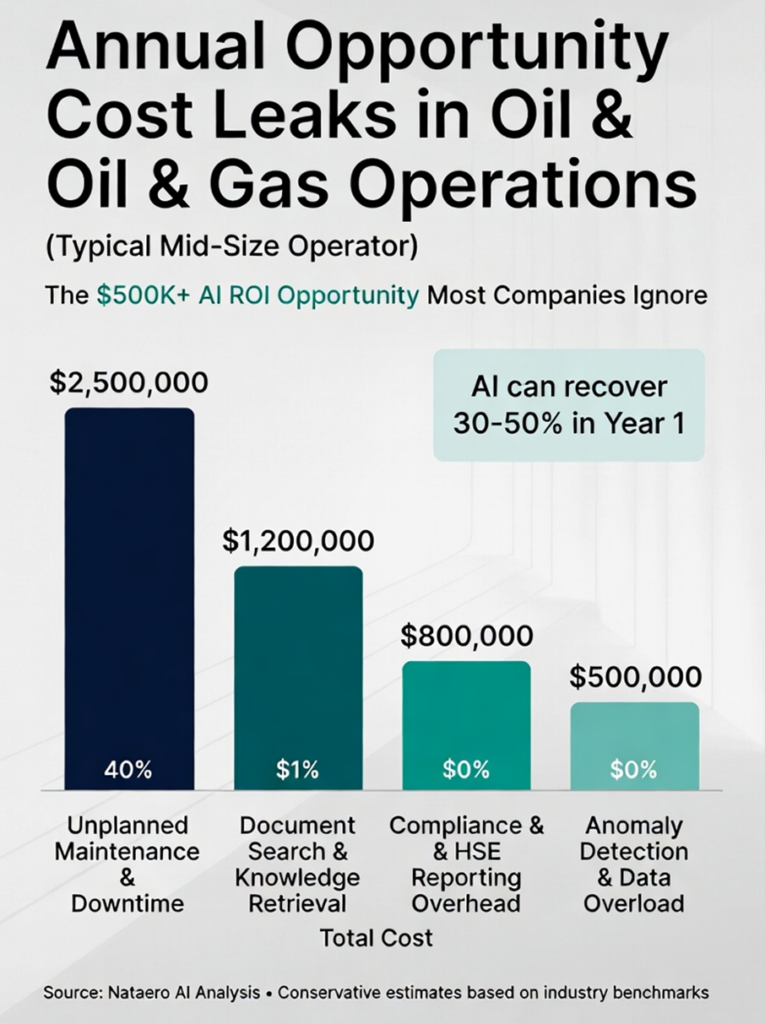
- Compliance Reporting and HSE Documentation Overhead Between FERC, EPA, OSHA, and state requirements, the average mid-size operator manages hundreds of recurring reports. The manual work — data collection, formatting, cross-referencing — is repetitive and error-prone.
AI document intelligence and HSE reporting automation can cut compliance labor by 40–60% while reducing regulatory violation risk.
- Document Search and Knowledge Retrieval Engineers spend 20–30% of their time searching for well reports, maintenance histories, or contract clauses. For a team of 20 at $120/hour fully loaded, that’s over $1.2M per year in lost productivity alone.
AI document intelligence oil and gas typically slashes retrieval time by 80–90%.
- Anomaly Detection and Operational Data Overload SCADA systems and IoT sensors generate millions of data points daily. No human team can monitor everything. Anomalies go unnoticed until they become incidents.
AI models monitor every stream 24/7 and flag issues early — preventing damage, environmental impact, and reputational harm.
What AI Actually Automates — And What It Doesn’t
AI is well-suited to pattern recognition in large datasets, repetitive document processing, scheduling optimization, anomaly flagging, and routine report generation.
AI is not suited to novel engineering decisions, regulatory interpretation, stakeholder negotiation, or any task requiring deep contextual judgment outside its training data.
The most successful AI in energy sector deployments augment engineers — they don’t replace them. They eliminate the tedious work so human expertise focuses on what truly moves the needle.
High-ROI Entry Points for Oil & Gas Companies
Based on real deployments, these three use cases deliver the fastest AI ROI in oil and gas:
- Predictive Maintenance → Highest-ROI entry point for asset-heavy operators. Uses existing sensor and historian data. Visible ROI often in 60–90 days through avoided downtime.
- HSE Reporting Automation → Lower complexity, fast deployment. Cuts reporting labor 40–60% and improves audit readiness.
- Document Intelligence → Immediate impact. Natural-language search across reports, logs, and contracts. Time-to-value: 2–4 weeks.
Not sure where to start? Nataero’s Strategic Assessment identifies your highest-value AI opportunity in a structured 2–3 week engagement — no vendor pitch, no pressure.
→ Schedule a Strategic Assessment: Request a Meeting
How to Calculate Your Own AI ROI Baseline in Oil & Gas
You don’t need to commit to anything to know the value at stake. This exercise takes under an hour.
Step 1 — Quantify unplanned downtime cost. Count last year’s shutdowns, estimate lost production + emergency costs, multiply by average.
Step 2 — Measure manual reporting and document labor. Ask leads for weekly hours spent on reporting, search, and data aggregation. Multiply by headcount, loaded rate, and 52 weeks.
Step 3 — Apply a conservative 30–50% recovery rate. The result is a defensible first-year AI ROI projection most operators can put in front of their CFO immediately.
Operators who run this calculation almost always discover their conservative projection exceeds the cost of an initial engagement.
Frequently Asked Questions
What’s a realistic ROI timeline for AI in oil and gas? Focused use cases (predictive maintenance, document intelligence) deliver measurable ROI in 60–90 days. Broader programs reach payback in 6–12 months. Scope clarity and data readiness are the biggest variables.
Where should we start with AI if we’re new to it? Start with whatever costs you the most or consumes the most engineer time — usually unplanned downtime or document search. A narrow, well-scoped first project builds confidence fast.
Does our data need to be perfect before we start? No. It needs to be adequate for the chosen use case. Our assessment evaluates your data and runs quality work in parallel with early implementation.
Our data is highly sensitive. How do we keep it secure? Nataero deploys AI inside your environment, behind your security perimeter. Your well data, SCADA feeds, and records never leave your infrastructure. Full documentation is provided for legal/IT review.
Know Your Number Before You Decide Anything
Nataero’s Strategic Assessment delivers a clear picture of your highest-value AI opportunities in oil and gas, realistic timelines, and a phased roadmap — without disrupting operations or locking you into premature technology choices.
Schedule a Strategic Assessment → Contact Us
Learn More – Forbes AI in Oil & Gas