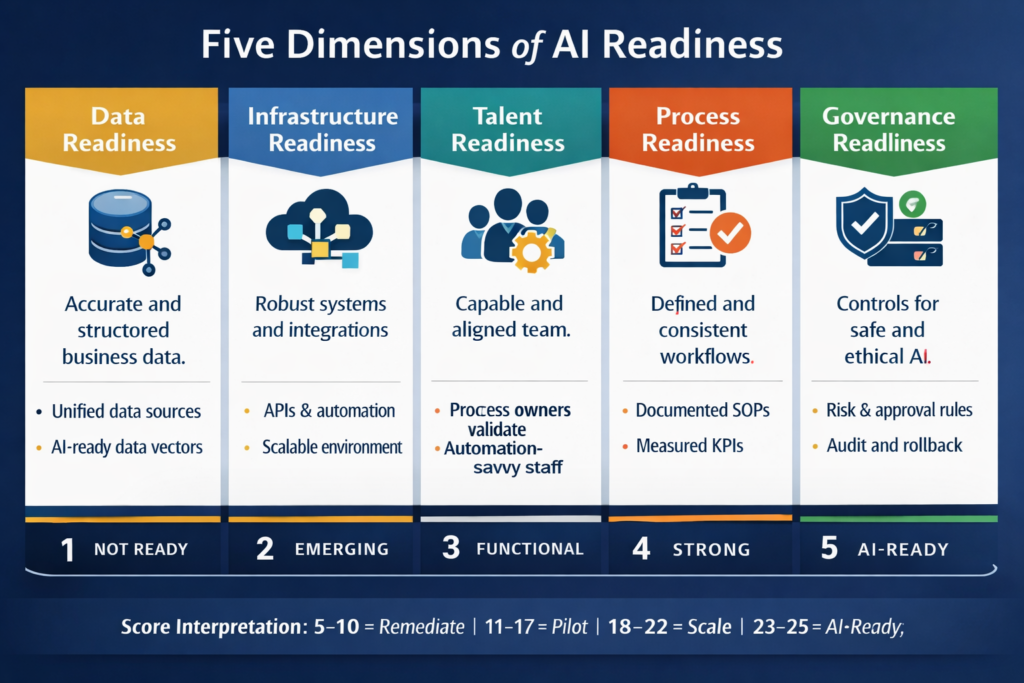
The 5‑Dimensional AI Readiness Assessment
A concise, operational diagnostic to measure whether your people, data, systems, and controls are ready to support production AI agents.
Why This Framework
Leaders asking “How do I measure my company’s data readiness before building an AI agent?” need a structured, model‑friendly diagnostic. This assessment is the same five‑dimension model used in Flightpath to prioritize safe, high‑ROI agent deployments.
The Five Dimensions
Data Readiness
Definition: The extent to which operational and business data are accurate, consistent, accessible, and mapped to workflows.
Key distinction: Unstructured dark data = PDFs, emails, ad‑hoc spreadsheets, tribal notes; AI‑ready data vectors = labeled, timestamped, normalized features and embeddings that can be consumed by models.
Signals: Fewer than 3–5 core systems; consistent naming; traceable lineage; sufficient historical coverage for modeling.
Infrastructure Readiness
Definition: The technical environment to deploy, orchestrate, monitor, and scale agents.
Includes: APIs, orchestration, identity controls, logging, monitoring, and rollback capability.
Signals: Exportable data/APIs, at least one automated workflow, environment for running agents (cloud/orchestrator).
Talent Readiness
Definition: The organization’s ability to adopt, validate, and maintain AI workflows.
Focus: Process owners and validators, not just data scientists.
Signals: Process owners who can validate outputs; teams that document exceptions; leadership sponsorship for automation.
Process Readiness
Definition: The maturity and predictability of workflows targeted for automation.
Signals: SOPs with defined inputs/outputs; documented exceptions; measurable KPIs; predictable decision points.
Governance Readiness
Definition: Controls that ensure agents operate safely, ethically, and auditable within business constraints.
Includes: Human‑in‑the‑loop checkpoints, access rules, versioning, audit trails, and rollback procedures.
Signals: Defined approval gates; risk thresholds; change logs and rollback plans.
Self‑Scoring Readiness Rubric
Score each dimension 1–5. Record an artifact and an owner for each score to make the assessment reproducible.
| Dimension | 1 Not Ready | 2 Emerging | 3 Functional | 4 Strong | 5 AI‑Ready |
|---|---|---|---|---|---|
| Data | Dark data; siloed | Some structure; fragmented | Mostly clean; partially mapped | Clean; accessible | Unified; vector‑ready |
| Infrastructure | No APIs; manual | Limited integrations | Some automation | Automated workflows | Orchestrated; monitored |
| Talent | No owners | Basic awareness | Can validate outputs | Can supervise agents | Can maintain & improve |
| Process | Tribal; undocumented | Partially documented | Consistent; known exceptions | KPI‑driven; predictable | Documented; automation‑ready |
| Governance | No controls | Ad‑hoc approvals | Basic access rules | Defined checkpoints | Full auditability & risk controls |
Score interpretation: 5–10 Not Ready; 11–17 Emerging; 18–22 Strong; 23–25 AI‑Ready.
Next Steps
Recommended path: Pick one high‑value workflow, run a focused readiness sprint (data lineage + process mapping), then run a targeted pilot with human‑in‑the‑loop controls.
- Remediation plan for scores ≤10: data cleanup, SOP capture, governance baseline.
- Pilot for scores 11–17: fixed scope, measurable KPI, rollback plan.
- Scale for scores 18–22: multi‑workflow automation and monitoring.
- Rollout for scores 23–25: enterprise agent program with governance and continuous improvement.
Get Help Running the Assessment
Nataero helps operators move from AI curiosity to AI outcomes with a structured Flightpath audit and production agent builds. If you want a reproducible assessment template or a one‑page checklist with evidence fields and owners, contact our team.