

The Work Nobody Wants to Do Is Disappearing
AI agents are not a future promise. They are running in production inside real businesses right now.
Not replacing people. Replacing the repetitive, structured, manual work that drains capacity from every team in a growing SMB.
Think about the average week inside your organization. Someone is pulling data from one system and pasting it into another. Someone is formatting reports that could be auto-generated. Someone is chasing follow-ups that should trigger automatically. Someone is reconciling numbers across spreadsheets that were never meant to be separate.
That is 10 to 20 hours per week, per team, of recoverable time. And AI agents are recovering it now.
An AI agent is a software system that autonomously executes multi-step workflows by perceiving inputs, making rule-based decisions, and triggering actions across connected business systems — without requiring human intervention at each step. Unlike a chatbot that answers questions or a dashboard that displays information, an agent takes action: it monitors, decides, and executes.
The numbers support the shift. Gartner predicts that by 2026, 40% of enterprise applications will include task-specific AI agents, up from less than 5% in 2025. McKinsey projects AI-powered agents could generate roughly $2.9 trillion in U.S. economic value per year by 2030. And businesses using AI automation report a 35% average reduction in operational costs within the first year of adoption.
SMBs are moving fast. AI automation adoption among small and mid-sized businesses nearly doubled between 2024 and 2026, climbing from 22% to 38%. The businesses deploying agents are not doing anything exotic. They are identifying high-volume manual workflows, mapping the decision logic, and handing off execution.
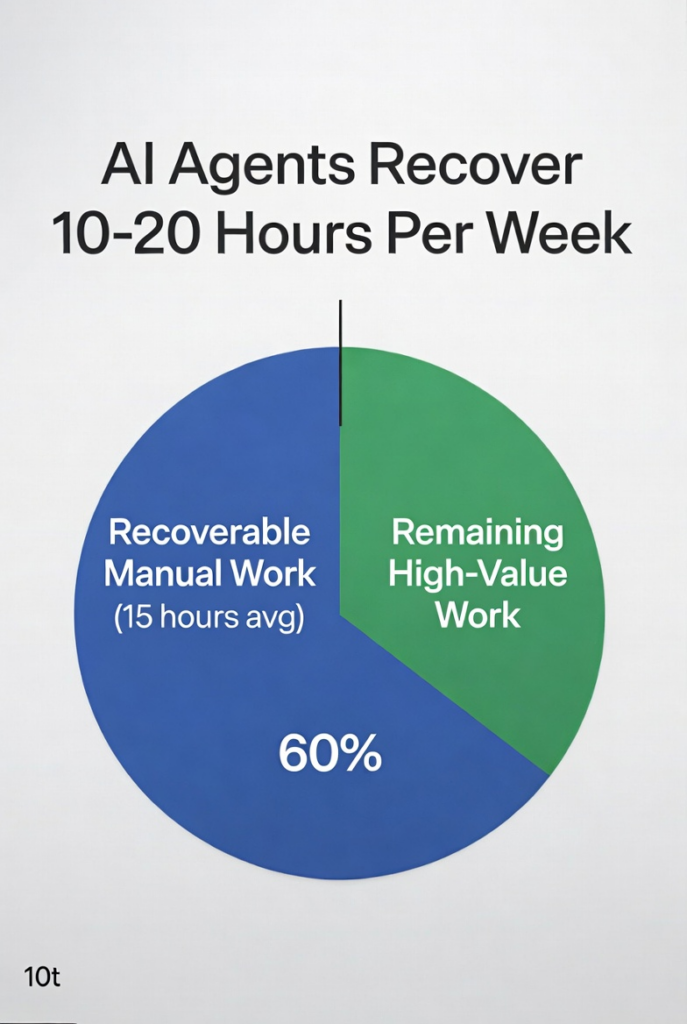
Pie chart showing AI agents recover 10–20 hours of manual work per week in SMBs
Not replacing people. Replacing the repetitive, structured, manual work…
An AI agent is a software system that autonomously executes multi-step workflows by perceiving inputs, making rule-based decisions, and triggering actions across connected business systems — without requiring human intervention at each step.
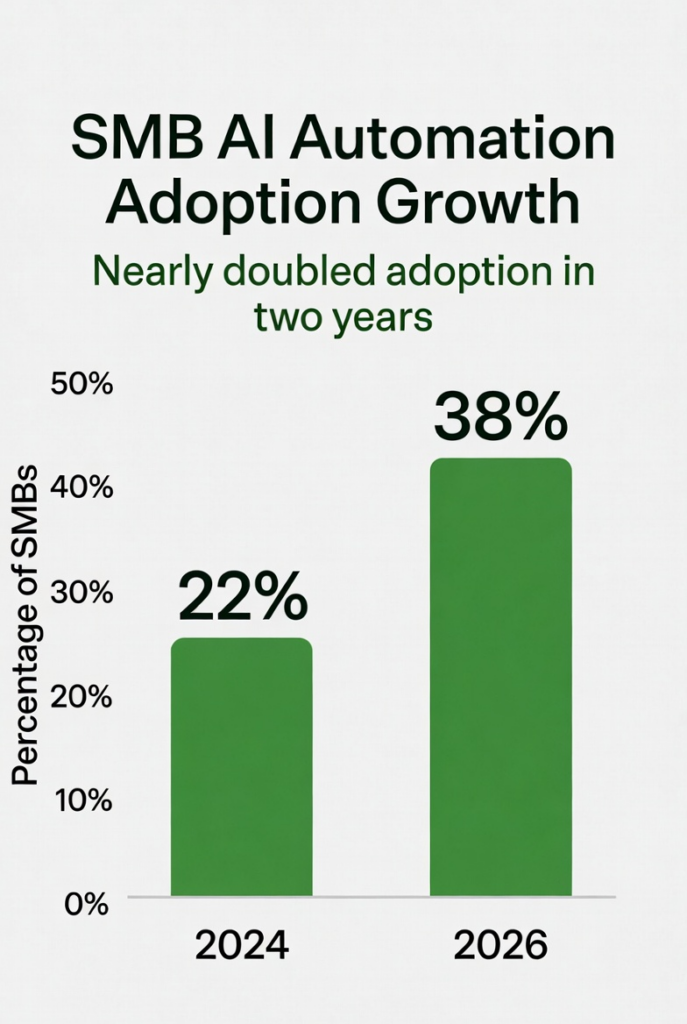
Bar chart showing SMB AI automation adoption nearly doubled from 22% in 2024 to 38% in 2026
The numbers support the shift…
Here are five workflows where AI agents are saving real hours right now.
AI workflow automation for SMBs : Invoice Processing: From Six Hours to Twenty Minutes
An AI agent monitors incoming invoices, extracts key fields — vendor name, amount, line items, due date — matches them against purchase orders, flags discrepancies, and routes approvals to the right person based on predefined rules.
What used to take a finance team member six hours a week now requires roughly 20 minutes of oversight. The agent handles the extraction, matching, and routing. The human reviews exceptions and approves.
This is one of the highest-ROI agent deployments because the workflow is entirely structured: the inputs are standardized documents, the logic is rule-based, and the outputs are approvals or escalations. At Nataero AI, invoice processing is consistently the first agent workflow we deploy because the time savings are immediate and measurable.
Customer Onboarding: Eliminating the 12-Step Checklist
A new customer signs up. The agent triggers the full onboarding sequence automatically: welcome emails, account configuration, internal notifications to the account team, task creation in your project management tool, CRM record updates, and calendar invitations for the kickoff call.
Nobody has to remember the 12-step checklist anymore. Nobody has to manually send the welcome email, then switch to the CRM, then create the tasks, then notify the team. The agent collapses a multi-system, multi-step process into a single trigger.
The impact goes beyond time savings. Automated onboarding eliminates the variability that comes with manual execution. Every customer gets the same experience. Every internal team gets notified on the same timeline. Nothing falls through the cracks because someone was out sick or overwhelmed with other work.
Weekly Report Generation: Delivered by Monday Morning
Instead of someone spending Friday afternoon pulling numbers from three systems, copying them into a slide deck, formatting tables, and emailing the result — the agent aggregates data from your CRM, accounting platform, and operations tools, formats it into your standard template, and delivers the finished report by 8 AM Monday.
The person who used to build that report now reviews it in 10 minutes instead of building it in three hours.
Report generation is a high-frequency, low-judgment workflow — the exact profile AI agents handle best. The data sources are known, the format is consistent, and the logic is repeatable. The only human input needed is the interpretation of results, which is where your team’s expertise actually matters.
AI Lead Qualification: Score, Enrich, and Route Automatically
Inbound inquiries arrive through your website, email, or ad campaigns. The agent reviews each submission, scores it against your ideal customer profile criteria, enriches the record with firmographic data, and makes a routing decision: qualified leads go directly to sales with context attached, while lower-scoring inquiries enter a nurture sequence automatically.
No spreadsheet. No manual review of every inquiry. No leads sitting in an inbox for 48 hours while a rep decides whether to follow up.
Speed matters in lead qualification. Research consistently shows that response time is one of the strongest predictors of conversion. An agent that qualifies and routes a lead in minutes gives your sales team a structural advantage over competitors who take hours or days to respond.
SOP Compliance Monitoring: Catching Drift Before It Compounds
Standard operating procedures exist for a reason, but enforcing them manually is nearly impossible at scale. The agent watches for deviations in real time: missed steps in a process, incomplete forms, out-of-sequence actions, skipped approvals.
Instead of discovering process drift during a quarterly audit — after weeks of compounded errors — the agent flags deviations as they happen. The relevant team member gets an immediate notification with the specific step that was missed and the action needed to correct it.
This is particularly valuable in regulated industries or any business where consistency directly affects quality, compliance, or customer experience. At Nataero AI, we have deployed SOP compliance agents for clients in manufacturing, professional services, and healthcare administration where process discipline is non-negotiable.
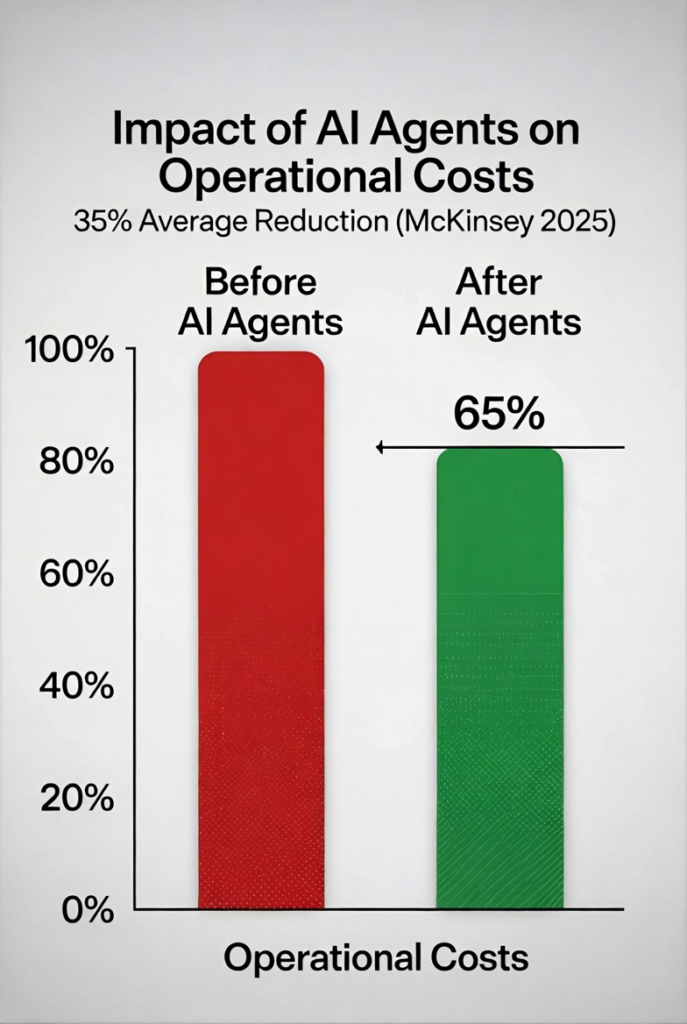
Bar chart showing 35% average reduction in operational costs after implementing AI agents (McKinsey 2025)
How to Identify Which Workflows to Automate First
Not every workflow is a good candidate for an AI agent. The ones that deliver the fastest ROI share three characteristics:
- High volume and high frequency. The workflow happens daily or weekly, involves multiple repetitions, and consumes meaningful hours. Invoice processing, data entry, report building, and follow-up sequences all qualify.
- Structured and rule-based logic. The decisions within the workflow follow predictable patterns. If the logic can be written as “if X, then Y” rules, an agent can execute it. Judgment-heavy, ambiguous decisions remain human work.
- Multi-system execution. The workflow requires moving information between two or more systems — CRM to email, accounting to reporting, form submission to task management. Agents excel at orchestrating across systems because they eliminate the manual copy-paste layer.
Most SMBs have at least three workflows that meet all three criteria and could be automated within 90 days. Start by auditing where your team spends the most time on tasks that follow the same pattern every week. Those hours are recoverable.
If your team is spending hours on tasks that follow the same steps every time, those hours are recoverable. Nataero AI helps SMBs identify, design, and deploy AI agents that automate structured workflows and deliver measurable ROI.
Want to find the 10–20 hours hiding in your team’s week?
Book a free workflow audit with Nataero AI.
Link to nataeroai.com/contact
Frequently Asked Questions
What can AI agents automate?
AI agents automate structured, repeatable workflows that follow rule-based logic. Common use cases include invoice processing, customer onboarding, report generation, lead qualification and routing, data entry across systems, follow-up sequences, and SOP compliance monitoring. Agents handle the execution; humans handle the judgment and exceptions.
How much time do AI agents actually save?
Most SMBs recover between 10 and 20 hours per week per team after deploying AI agents on their highest-volume workflows. Individual workflow savings vary — invoice processing alone can drop from six hours to 20 minutes of oversight, and report generation can go from three hours of manual assembly to 10 minutes of review.
Are AI agents replacing employees?
AI agents replace tasks, not people. They handle the manual, repetitive execution that consumes capacity — the data entry, the formatting, the routing, the follow-ups. The people who used to do that work shift to higher-value activities: interpreting results, managing exceptions, building relationships, and making strategic decisions.
How do SMBs get started with AI agents?
Start by auditing your team’s weekly workflows for tasks that are high-volume, rule-based, and involve moving data between systems. Those are your highest-ROI automation candidates. Most SMBs can identify and deploy their first agent within 90 days with the right partner and framework.