

How Energy Companies Are Turning Document Chaos into Competitive Advantage—Without Compromising Security
The oil and gas industry generates an astonishing amount of documentation. From drilling permits and safety protocols to equipment records and compliance reports, the average operation manages thousands of critical documents across multiple sites, offshore platforms, and field locations.
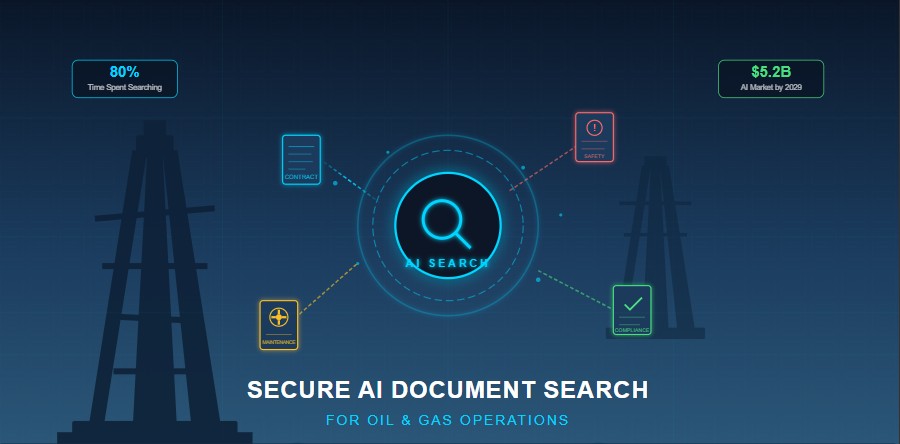
Here’s the sobering reality: According to Equinor’s CIO, 80% of employee time in the oil and gas industry is spent looking through unstructured data to inform decisions and get work done. That’s not a typo. Four out of every five hours of knowledge work is spent searching, not doing.
The industry is responding. The global AI market in oil and gas is projected to reach $5.2 billion by 2029, and document management sits at the heart of this transformation. But there’s a catch: oil and gas companies face uniquely strict security requirements. Regulatory frameworks, competitive intelligence, and operational safety demand that sensitive documents never leave controlled environments.
This is where Nataero changes the equation. Instead of uploading documents to AI systems (and the security nightmares that creates), Nataero brings secure AI to your documents—processing everything in place with complete audit trails and zero data exposure.
Let’s explore three high-impact use cases where AI-powered document search delivers measurable business value for oil and gas operations.
Use Case 1: Contract Management & Renewal Intelligence
The Problem
Oil and gas operations depend on complex webs of contracts: land leases, vendor agreements, equipment rentals, service contracts, and joint venture arrangements. A mid-sized operator might manage 10,000+ active contracts across dozens of sites.
The typical scenario? A pipeline maintenance contract auto-renews at last year’s inflated rates because no one caught the 60-day cancellation window buried in page 47. Or a vendor’s insurance lapses, and the lapse only surfaces after an incident occurs. These aren’t hypothetical risks—they’re weekly realities.
Document management is a life-critical standard in oil and gas. As one industry document control supervisor noted: “If someone follows an out-of-date procedure or works from an unapproved version, it could result in people being harmed or killed.”
How AI Document Search Solves It
With Nataero’s secure AI search, operations teams can:
- Surface expiring contracts automatically. Ask questions like “Show me all contracts expiring in the next 90 days” and get instant, comprehensive answers—even when contracts are stored across SharePoint, cloud storage, and legacy systems.
- Find specific terms across thousands of documents. Need to know which vendor agreements include price escalation clauses? Which leases have mineral rights restrictions? Traditional search fails because these terms are expressed differently in every document. AI understands the meaning behind your questions.
- Track insurance certificates, certifications, and compliance deadlines. Instead of maintaining manual spreadsheets that fall out of date, let AI surface documents by their real-world implications.
Business Value
Industry data suggests that AI-enabled contract management can identify 5-15% cost savings on vendor spend through better visibility into renewal terms and pricing opportunities. For a company with $100M in annual vendor contracts, that’s $5-15M in recoverable value—often from contracts that were already signed but poorly monitored.
Related resource: The Importance of Effective Document Management for the Oil and Gas Industry
Use Case 2: Safety Incident Investigation & Pattern Recognition
The Problem
When a safety incident occurs, investigation teams need to answer a critical question: Has this happened before?
The answer almost always exists somewhere in your documentation—previous incident reports, near-miss logs, equipment maintenance records, and inspection histories. But finding these connections manually is like searching for needles in thousands of haystacks. Investigation teams spend days or weeks assembling documentation that AI could surface in seconds.
More importantly, pattern recognition happens too late. Human reviewers can’t possibly cross-reference every equipment failure, every maintenance deviation, and every environmental anomaly across years of records and dozens of sites. The signals exist. They’re just buried.
How AI Document Search Solves It
Nataero’s approach enables safety and operations teams to:
- Find all related incidents instantly. Query “Show me all incidents involving Compressor Unit A7 across all sites” and receive comprehensive results regardless of how incidents were categorized or where reports were filed.
- Surface patterns human review would miss. AI can identify connections between seemingly unrelated events—a maintenance deviation at one site, a supplier quality issue at another, and an equipment failure a month later—that indicate systemic risks.
- Accelerate root cause analysis. When investigators can access every relevant document in minutes rather than days, investigations complete faster, and corrective actions deploy sooner.
Business Value
Industry research shows that AI-powered safety systems can reduce incident response times by 40-60% and improve near-miss capture rates by identifying patterns that lead to proactive interventions. In an industry where a single serious incident can cost tens of millions in direct and indirect costs, prevention delivers extraordinary ROI.
Beyond cost avoidance, there’s a human imperative. Every pattern caught early is a potential injury prevented.
Related resource: AI in Oil and Gas: Strategic Trends, Challenges, and Use Cases — Society of Petroleum Engineers
Use Case 3: Regulatory Compliance & Audit Readiness
The Problem
Oil and gas operations face some of the most demanding regulatory environments in any industry. Environmental permits, safety certifications, HSE compliance, OSHA requirements, EPA mandates, ISO standards—the list continues. And every requirement comes with documentation demands.
Audit preparation is particularly painful. When regulators arrive (often with limited notice), teams scramble to locate, verify, and produce documents that may be scattered across systems, sites, and storage formats. A typical audit preparation cycle consumes hundreds of person-hours—time that could be spent on actual operations.
The risk isn’t just inefficiency. Missing documentation, outdated records, or inconsistent versions can trigger violations, fines, and operational shutdowns. In highly regulated sectors, compliance documentation isn’t optional—it’s existential.
How AI Document Search Solves It
Secure AI document search transforms compliance from a fire drill into a sustainable practice:
- Pull every relevant document in minutes, not weeks. When auditors ask for “all environmental monitoring records from Q3 2024,” the answer should take seconds. Nataero makes that possible without complex queries or expert knowledge of your filing systems.
- Track who accessed what, when. Complete audit trails satisfy chain-of-custody requirements and demonstrate document integrity. Every search creates a record.
- Maintain version control visibility. Which version of Safety Procedure SP-102 was in effect on March 15? AI search can answer questions about document states at specific points in time—critical for demonstrating compliance.
- Set department-specific permissions. Your IT team maintains complete control over who can access which documents. AI search respects and enforces existing access controls.
Business Value
Audit preparation time reductions of 70-80% are commonly reported when organizations implement AI-powered document search. For a company that previously dedicated three full-time employees to audit prep each quarter, that’s substantial capacity returned to operational work.
More significantly, research on AI adoption in oil and gas indicates that improved compliance posture reduces regulatory risk exposure and can lower insurance costs by demonstrating superior operational controls.
Related resource: Document Management Software for the Oil and Gas Industry — ComplianceQuest
Why Security-First AI Matters for Oil & Gas
These use cases share a common requirement: the solution must be secure enough for an industry that can’t afford data exposure.
Traditional AI approaches require uploading documents to cloud-based systems—a non-starter for most oil and gas operations. Proprietary drilling data, competitive lease information, and safety records can’t leave controlled environments. Period.
Nataero’s architecture inverts the model:
- Documents never leave your environment. Your files stay in SharePoint, cloud storage, or network drives. The AI processes everything in place.
- Zero uploads. Zero exposure. Nothing gets transmitted to external systems. Your competitive intelligence stays yours alone.
- 3-hour deployment. No data scientists. No months of setup. No complex migrations. If you have Snowflake (or one hour to set it up), you’re ready.
- Concurrent licensing that makes sense. Why pay for 500 licenses when only 15 people search simultaneously? Nataero’s pricing scales with actual usage.
Getting Started
The oil and gas industry is at an inflection point. Companies that deploy AI effectively will respond to clients faster, surface insights others miss, and operate more safely than competitors still debating security trade-offs.
The debate itself is the problem. While you evaluate whether AI is secure enough, AI-powered competitors are already finding opportunities you don’t even know exist.
Schedule a demo with Nataero to see exactly how your team can search thousands of documents in seconds—while your data stays exactly where it is.
Nataero provides secure AI-powered document search for oil and gas, legal, finance, and other regulated industries. Learn more at nataero.ai.